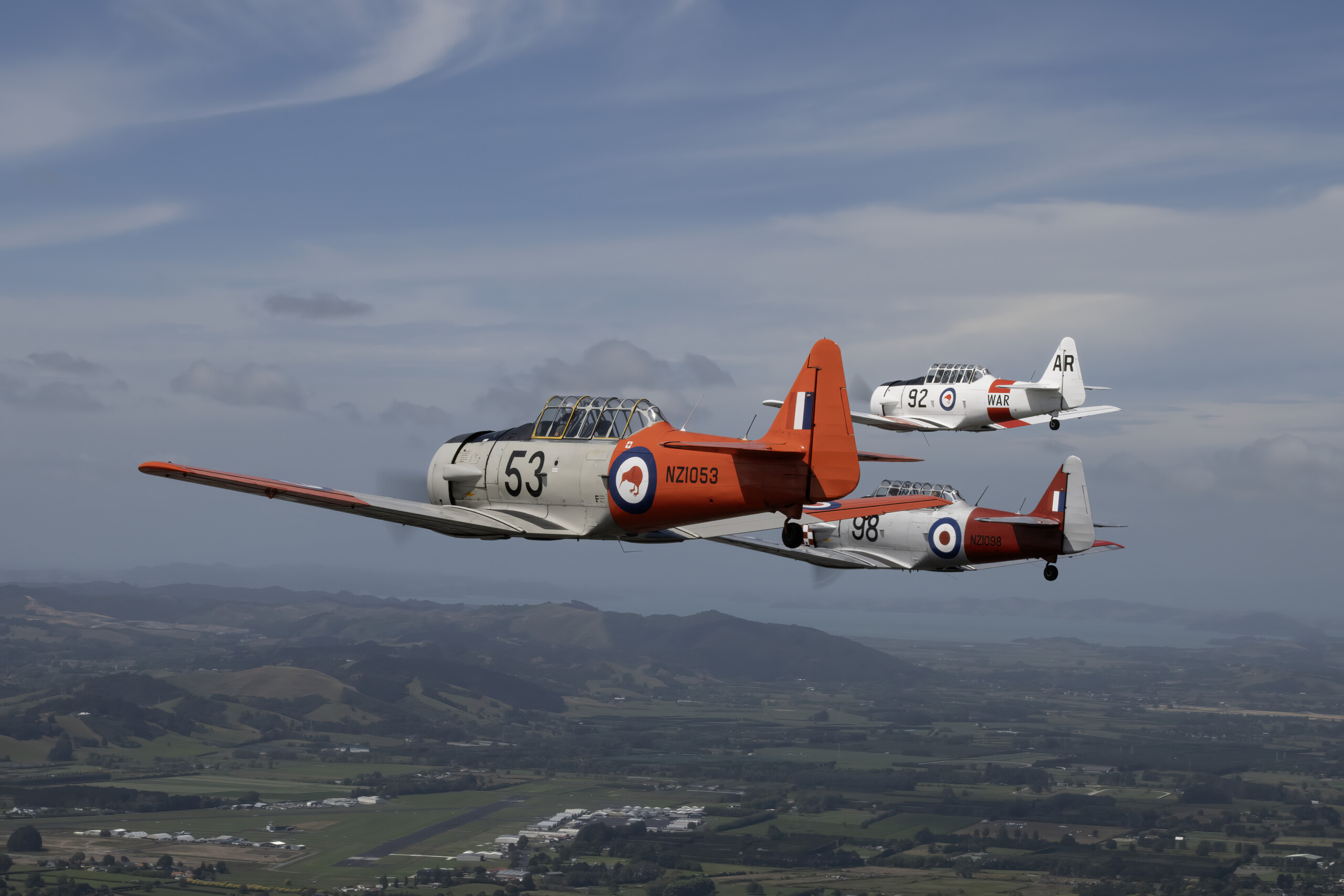

Every year, the New Zealand Warbirds Association takes part in Battle of Britain commemorations and stages a flypast over the Auckland War Memorial Museum and Cenotaph. The combination of the 60th anniversary of the battle and the large number of aircraft taking part in the event generated much media interest.
Finest Hour
                                               Sir Winston Churchill, June 1940

Warbirds fly past to mark finest hour
By SCOTT MacLEOD
From the New Zealand Herald September 18, 2000

NZ Herald photo
Air Training Corps Flight Sergeant Deborah Kendon
stands to attention as the Warbirds roar overhead.
                                                                          NZ Herald Photo

Sixty years ago, one of the most important air battles in history erupted over southern England - a battle in which "the few" of Britain kept Adolf Hitler's Luftwaffe at bay. Yesterday, those few were even fewer, but their deeds in winning the Battle of Britain were remembered when warbird aeroplanes roared over Commonwealth cities in commemoration.

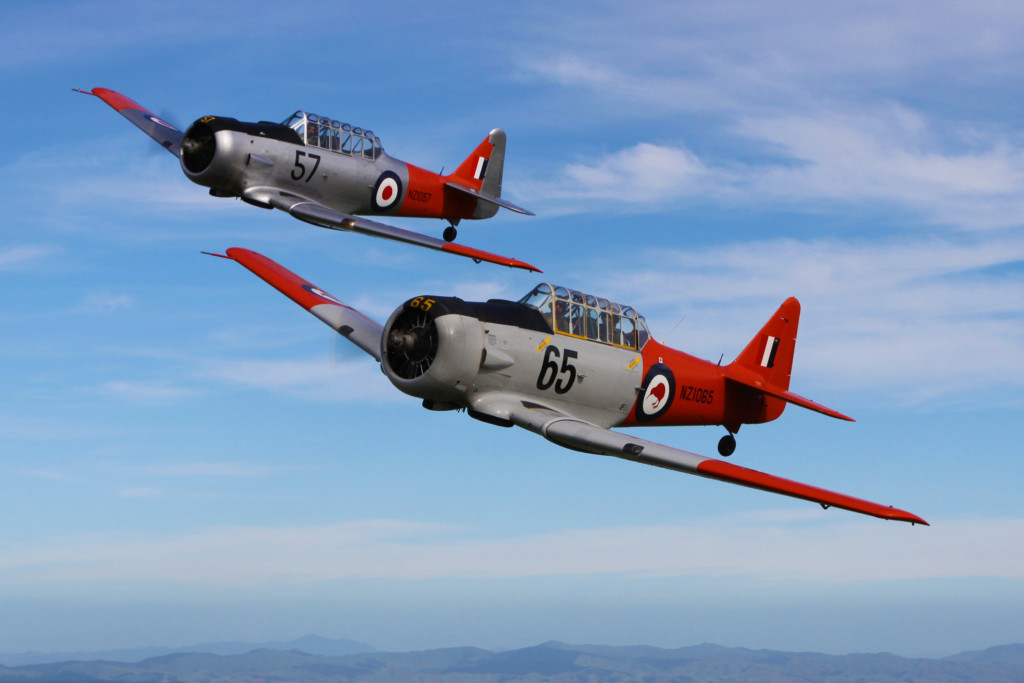
Auckland's highlight was at 11 am, when 22 antique aircraft soared over a service at the war memorial museum. The planes included a Catalina flying boat, DC3 transport, Harvard trainers and a Tiger Moth biplane.
NZ Warbirds Association president Trevor Bland said the Battle of Britain was a pivotal conflict.
"If Britain had fallen, then others would have followed suit, and America may not have entered the war.
"And there were a large number of Kiwis involved - a large percentage of the few."

The battle started in mid-August 1940, when the Luftwaffe sent fighter and dive-bomber planes against ports in southern England. The British claimed they shot down 700 aircraft in the first 10 days, for the loss of 160 Spitfire and Hurricane fighters. The Germans then started bombing airfields and factories, a tactic which nearly won the battle despite the loss of another 560 planes. But British bombing raids on German cities enraged Hitler, who ordered his planes to attack cities instead. That was a mistake because it let the British rebuild their air forces. The battle peaked on September 15, 1940 - when 200 dogfights took place in 30 minutes.

One New Zealander who made a big impact was the commander of 11 Group, Sir Keith Park. Waikanae veteran Stewart Lusk is one of about 20 New Zealanders still alive who fought in the battle. Squadron Leader Lusk flew lumbering two-engined Blenheim bombers that had been converted to night-fighters and equipped with virtually useless radar. They were often shot at by British fighter pilots and seamen, who mistook them for enemy craft. Mr Lusk flew through the entire war without shooting down any Germans, but during one flight he was attacked by a gaggle of Stuka bombers that were, in turn, mauled by British Hurricane fighters. "It was pretty dangerous work," he said. "Anything with two engines was fair game for some of the Spitfire and Hurricane pilots."

After yesterday's flypast, about 10,000 people turned up to an open day at Ardmore Airfield in South Auckland to view the 35 Warbirds assembled there. The favourite was the North American P51 Mustang, a long-range fighter plane used to escort heavy bombers over German cities.

In 1940, British Prime Minister Winston Churchill dubbed his pilots "the few," and predicted that even if the Empire and Commonwealth lasted 1000 years the air battle would still be their "finest hour."
Yesterday, Mr Lusk said the battle was indeed Britain's finest hour.

Reproduced with kind permission of The New Zealand Herald
Photo and text © 2000 New Zealand Herald
Never in the field of human conflict
                                                     Sir Winston Churchill, August 1940

The memorial and flypast picture gallery
Click on a link to view the full size picture in a new window. For best results, close the popup window before you click on another image.

Devon forms on Dakota's port wing
DHC1 Chipmunk in formation with DHC2 Beaver 
Orbiting Rangitoto while the aircraft form up
Devon and Catalina join up with the rest of the formation 
Inbound over Auckland city heading towards the Cenotaph
Memorial speeches at the Cenotaph
A moment of reflection on times past
"Lest we forget"
Kittyhawk, Fouga and Mustang dramatically herald the arrival of the NZ Warbirds 
6 Harvards lead the Bf108 over the crowd
Auckland War Memorial Museum and Cenotaph as seen from the Beaver 
Dakota and Catalina make their presence felt
de Havilland Rapide passes overhead
"Another time, another place ..."  Could almost be a scene from WW2 
"Harvard formation break." Back at Ardmore for landing 

For coverage of subsequent flypasts, visit Alex Mitchell's "Warbirds Over New Zealand"